📌 Case: Suez Canal Authority v. Owners of the "Ever Given"
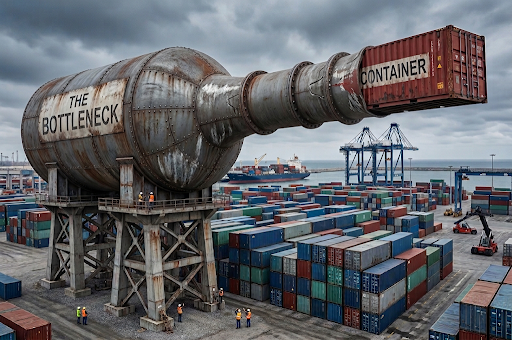
On March 23, 2021, a single 1,300-foot container ship ran aground and wedged itself sideways across the Suez Canal. For six days, roughly 10% of global trade sat parked in the desert. The Suez Canal Authority didn't just want the ship moved; it detained the Ever Given and its crew, filing a claim initially reported near $900 million for lost transit fees, reputational harm, and salvage costs, later cut to $550 million as negotiations dragged on. The ship wasn't released until the owners and the SCA reached a settlement in principle that June.
Overnight, one grounded ship became a choke point for global shipments. That means billions in downstream exposure for businesses that had nothing to do with the accident and everything to do with routing their goods through that stretch of water.
On the other side of the continent: China explores alternative routes
- Court: Ismailia Economic Court, Egypt (with related proceedings in the UK)
- Filed: March 2021
On March 23, 2021, a single 1,300-foot container ship ran aground and wedged itself sideways across the Suez Canal. For six days, roughly 10% of global trade sat parked in the desert. The Suez Canal Authority didn't just want the ship moved; it detained the Ever Given and its crew, filing a claim initially reported near $900 million for lost transit fees, reputational harm, and salvage costs, later cut to $550 million as negotiations dragged on. The ship wasn't released until the owners and the SCA reached a settlement in principle that June.
Overnight, one grounded ship became a choke point for global shipments. That means billions in downstream exposure for businesses that had nothing to do with the accident and everything to do with routing their goods through that stretch of water.
On the other side of the continent: China explores alternative routes
- In August 2026, Chinese carrier Sea Legend Shipping launched the first regular Arctic cargo service
- Sailing distance between Northeast Asia and Northern Europe cut by 30 to 40% compared to the Suez or Cape routes
- Type: a seasonal, geopolitically-loaded alternative
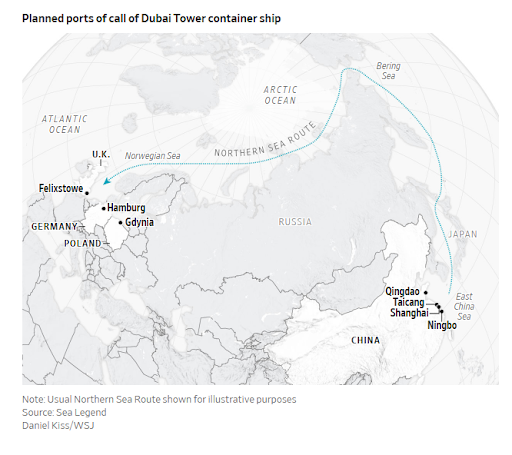
Chinese carrier Sea Legend Shipping (which operates a fleet of 17 vessels) launched the first regular commercial service on the Northern Sea Route, sailing from Zhoushan, China, across Russia's Arctic waters to Felixstowe in the UK. The lead vessel, the 1,740-TEU Dubai Tower, made the run in roughly 20 days, following a single trial voyage by its sister ship the Istanbul Bridge in 2025. The route cuts sailing distance between Northeast Asia and Northern Europe by 30 to 40% compared to the traditional path through the Suez Canal or around the Cape of Good Hope.
This isn't a year-round alternative: the service runs weekly through October 3, 2026, using seven vessels, because the route is only navigable for a narrow window each year before ice closes it again. The Northern Sea Route runs through Russian sovereign waters and is managed by Rosatom, Russia's state nuclear and Arctic infrastructure authority, which issues the transit permits. Any company routing cargo through Russian-administered Arctic infrastructure is operating inside a system controlled by a sanctioned state actor, which raises compliance and counterparty-screening questions.
Today’s geopolitical volatility
The Ever Given is just one example of what became a new normal. The list of things that can seize up a supply chain has only gotten longer and more geopolitical. Houthi attacks on Red Sea and the Strait of Hormuz disruptions have pushed carriers to reroute around the Cape of Good Hope and helped push oil above $100 a barrel this year. The Panama Canal's own drought crisis forced authorities to cut vessel traffic nearly in half at its worst, with a backlog that once topped 150 ships waiting to transit. And in October 2024, a three-day International Longshoremen’s Association strike shut down operations at roughly 100 East and Gulf Coast ports before a new six-year contract was finally ratified in early 2025.
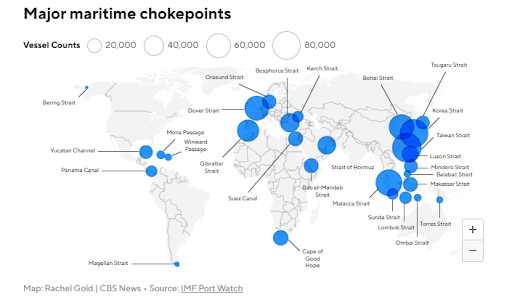
Fuel prices, closed ports, security threats, labor strikes: these are faces of the same underlying problem of shipping bottlenecks.
What businesses are doing about it?
Chokepoint Risk Architecture in Contracts
Contract architecture is one of the basic, yet effective ways to mitigate chokepoint risks. Most common tools that companies use are:
1. Named-Peril Force Majeure Language
Generic "events beyond the parties' control" language has less weight than a spelled out canal closure, port strike, labor stoppages, piracy or armed conflict along a shipping lane, and government-ordered rerouting. Naming the peril shifts the fight from "was this really unforeseeable" to "did the named event occur," which is a much easier case to win.
2. Alternative Routing / Diversion Clause
This clause gives a carrier or supplier the contractual flexibility to reroute shipments through an alternate port. The provision should also specify who absorbs the added transit time and cost of the diversion. Without this clause, a carrier's reasonable decision to avoid the Red Sea can become a contract dispute.
3. Freight and Fuel Index-Linked Surcharge Mechanism
Instead of a fixed freight rate that one side eats when bunker fuel prices spike or a rerouted voyage adds thousands of nautical miles, tie the surcharge to a public index (a bunker fuel index or a recognized freight rate benchmark). Both parties agree in advance on the formula and the trigger threshold, so a Red Sea-driven fuel spike adjusts the price automatically rather than sparking a renegotiation fight mid-shipment. This is the same logic as a Material Adverse Change clause, just calibrated specifically to freight and fuel volatility.
4. Notice-to-Cure and Grace Period Provisions
A short labor strike or a few days of port congestion shouldn't trigger an automatic default if the disrupted party can still perform once the disruption clears. Build in a defined notice period, a cure window, and a threshold for how long a delay has to run before it becomes an actual breach.
5. Multi-Carrier / Multi-Hub Step-In Rights
Reserve the contractual right to shift volume to a backup carrier, port, or logistics hub if your primary one fails to perform. This only works if you've pre-qualified the backup in advance; a step-in right is worthless if there's no one ready to step in.
A strong contract will include a named-peril language that specifically contemplates canal closures, port strikes, and rerouting; fuel and freight index-based surcharge mechanisms so a spike in bunker fuel prices doesn't sit entirely on one party; and defined notice-and-cure windows so a three-day strike doesn't automatically trigger a breach claim.
Bottom line
The Ever Given taught the world that one stuck ship can freeze billions in trade. China's 2026 playbook, building ships and opening new routes, is a useful lesson. Resilient companies invest in the capacity and alternative routes.
If your carrier reroutes around the Cape of Good Hope to avoid the Red Sea, who eats the extra fuel and time? Who is responsible for the last-mile leg?
What businesses are doing about it?
- Invest in Capacity. China's auto exports jumped 65% year-over-year in the first half of 2026, and there simply weren't enough car-carrier ships to move them. Charter rates for these vessels have climbed into the $80,000 to $90,000-a-day range. After ordering just nine new car-carriers in all of 2025, Chinese shippers have ordered more than 40 in 2026 alone. That's the lesson of strategic capacity investment.
- Build (or Buy Into) Alternative Routes. Sea Legend Shipping’s first regular Arctic cargo service, is an example of finding alternative routes. Though the Arctic route provides only a seasonal alternative with certain politically-charged risks, China shows the example of exploring alternative routes. Many companies started diversifying the shipping routes or sourcing.
Chokepoint Risk Architecture in Contracts
Contract architecture is one of the basic, yet effective ways to mitigate chokepoint risks. Most common tools that companies use are:
1. Named-Peril Force Majeure Language
Generic "events beyond the parties' control" language has less weight than a spelled out canal closure, port strike, labor stoppages, piracy or armed conflict along a shipping lane, and government-ordered rerouting. Naming the peril shifts the fight from "was this really unforeseeable" to "did the named event occur," which is a much easier case to win.
2. Alternative Routing / Diversion Clause
This clause gives a carrier or supplier the contractual flexibility to reroute shipments through an alternate port. The provision should also specify who absorbs the added transit time and cost of the diversion. Without this clause, a carrier's reasonable decision to avoid the Red Sea can become a contract dispute.
3. Freight and Fuel Index-Linked Surcharge Mechanism
Instead of a fixed freight rate that one side eats when bunker fuel prices spike or a rerouted voyage adds thousands of nautical miles, tie the surcharge to a public index (a bunker fuel index or a recognized freight rate benchmark). Both parties agree in advance on the formula and the trigger threshold, so a Red Sea-driven fuel spike adjusts the price automatically rather than sparking a renegotiation fight mid-shipment. This is the same logic as a Material Adverse Change clause, just calibrated specifically to freight and fuel volatility.
4. Notice-to-Cure and Grace Period Provisions
A short labor strike or a few days of port congestion shouldn't trigger an automatic default if the disrupted party can still perform once the disruption clears. Build in a defined notice period, a cure window, and a threshold for how long a delay has to run before it becomes an actual breach.
5. Multi-Carrier / Multi-Hub Step-In Rights
Reserve the contractual right to shift volume to a backup carrier, port, or logistics hub if your primary one fails to perform. This only works if you've pre-qualified the backup in advance; a step-in right is worthless if there's no one ready to step in.
A strong contract will include a named-peril language that specifically contemplates canal closures, port strikes, and rerouting; fuel and freight index-based surcharge mechanisms so a spike in bunker fuel prices doesn't sit entirely on one party; and defined notice-and-cure windows so a three-day strike doesn't automatically trigger a breach claim.
Bottom line
The Ever Given taught the world that one stuck ship can freeze billions in trade. China's 2026 playbook, building ships and opening new routes, is a useful lesson. Resilient companies invest in the capacity and alternative routes.
If your carrier reroutes around the Cape of Good Hope to avoid the Red Sea, who eats the extra fuel and time? Who is responsible for the last-mile leg?
Subscribe to my LinkedIn Newsletter and never miss a good read!
Share this blog post
Disclaimer: This blog post is not legal advice. It is for informational purposes only. Reading this content does not create an attorney-client relationship. Consult with a licensed attorney to address your specific issues. Do not act upon this information without seeking professional legal counsel. IB Law Firm does not endorse any of the cited sources and is not responsible for the content of linked resources